Build the simulation core for active magnetic shielding.

We are assembling a focused engineering team to build AegisTwin: a physics-tested simulation engine for high-energy particles and their interactions with EM fields, built for Aegis, the world's first commercial Active Magnetic Radiation Shielding venture.

  • PhasePrototype Sprint
  • FocusPhysics + CS + Commitment
  • ModelRemote-First Global

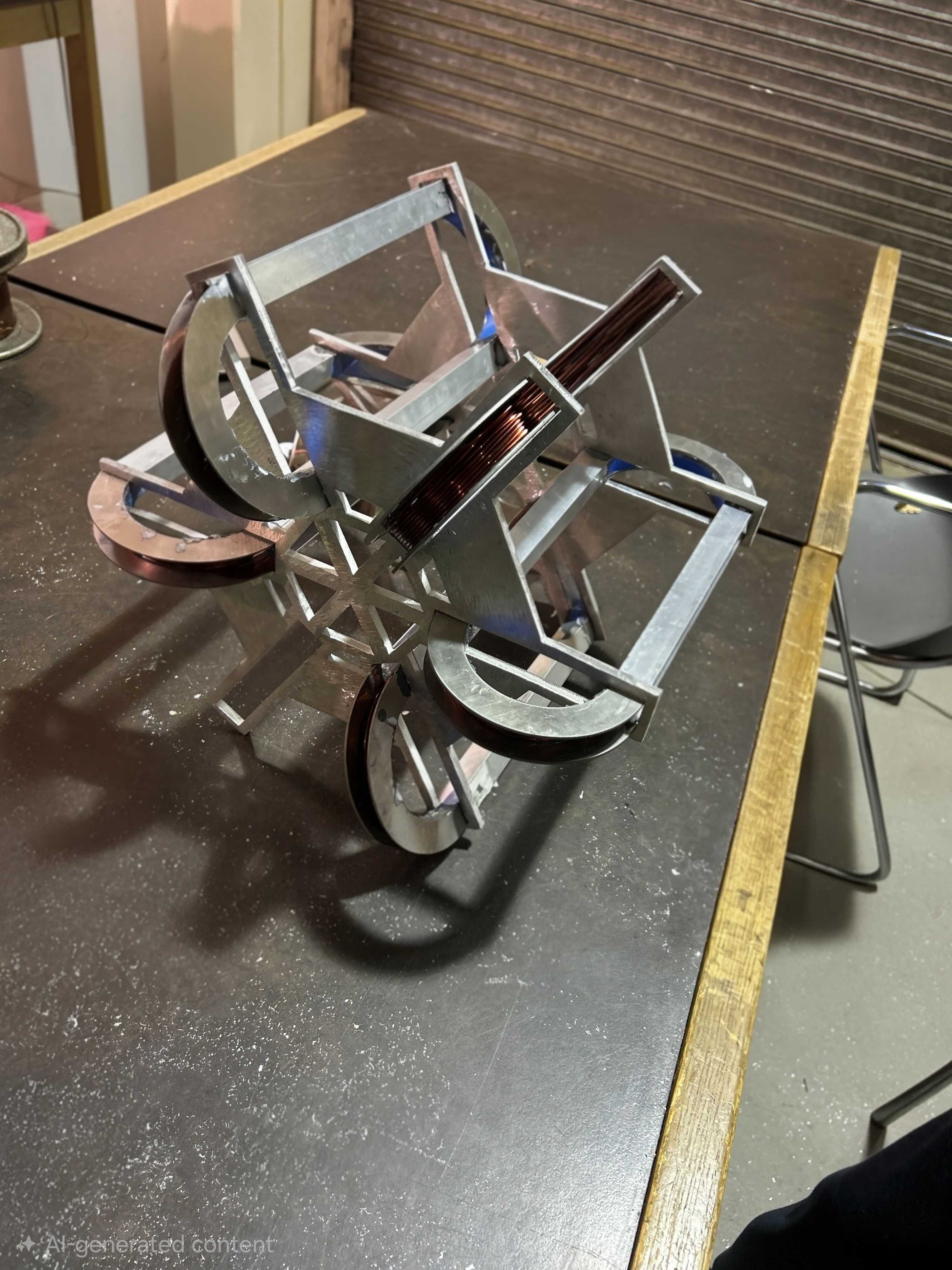
This design is for aesthetic reference only and does not represent our protected, novel concept or implementation.

Why This Matters

Deep-space missions are mass-limited. Passive shielding alone is not enough.

Traditional passive shielding is often too heavy and too bulky for long-duration missions. Active Magnetic Radiation Shielding (AMRS) offers a better path by deflecting harmful particles with fields, not just added mass. AegisTwin targets one practical question: which magnetic configurations deliver meaningful dose reduction while still being realistic to build?

What We Are Building

One integrated pipeline across field design, particle dynamics, and gap analysis.

We operate with a simulation-first design principle: the simulations we build are central to how we evaluate concepts and make engineering decisions. Compute-heavy workloads like Biot-Savart field solves and large-batch particle tracing are GPU-accelerated and dispatched to remote compute nodes, letting us run millions of trajectories per configuration.

Magnetic Configuration Builder

Create composable field geometries and solve volumetric B-fields via Biot-Savart integration on GPU.

  • Composable coil and solenoid primitives
  • GPU-accelerated field evaluation over 3D voxel grids
  • Tricubic interpolation for smooth field lookups

Isotropic Particle Shooter

Trace charged-particle trajectories through interpolated field volumes using symplectic integrators on GPU.

  • Isotropic source sampling over a bounding sphere
  • Boris or Verlet integration for energy-conserving trajectories
  • Massively parallel batch runs dispatched to remote compute nodes

Gap Analyzer and Field Reporter

Classify penetration events, map shielding weak points, and derive minimum field-strength requirements by solid-angle region.

  • Hit detection and angular penetration binning
  • Dose-proxy heatmaps and shielding-factor metrics
  • Per-region field-strength threshold reports
Particle trajectory deflection simulation.
Toroidal magnetic field and field-line visualization.
Laboratory build of a researched model tested by the engineering team.
Laboratory build of a researched model tested by our engineering team.

What We Look For

We're looking for 3 things:

Strong Relevant Physics

Deep understanding of the physics that matters here: particle dynamics, EM behavior, and radiation context.

Electromagnetics, Particle Dynamics, Radiation Physics

Strong CS Development

Ability to build production-grade simulation software with clean architecture, testing, and reliable execution.

Software Engineering, Numerical Computing, Validation

Dedication and Commitment

High responsibility, determination, and consistency to persist through difficult work and drive the project forward.

Responsibility, Reliability, Long-Horizon Execution

What We Offer

High-leverage upside for core contributors.

Negotiable Equity Shares

Equity participation can be discussed for strong contributors who commit to the mission.

Engineering x Software

A rare chance to work at the intersection of engineering constraints and software simulation.

Pathway to Paid Work

As funding comes in, high-performing contributors have a clear pathway into paid roles.

Clear Direction

You'll always know what matters and why. Clear milestones, direct access to decision context, and a team that communicates openly.

AegisTwin Builder Application

AegisTwin Builder Application

This focused intake assesses relevant physics depth, CS development strength, and dedication to the AegisTwin project. Clarity and technical signal are prioritized over polished resumes.

* Indicates required question